Four vaccines during pregnancy. Tdap, COVID-19, influenza, and RSV. All are presented by the mainstream as ways to protect a mother and her unborn child. But how many expectant mothers have actually read the manufacturers’ package inserts before rolling up their sleeves?
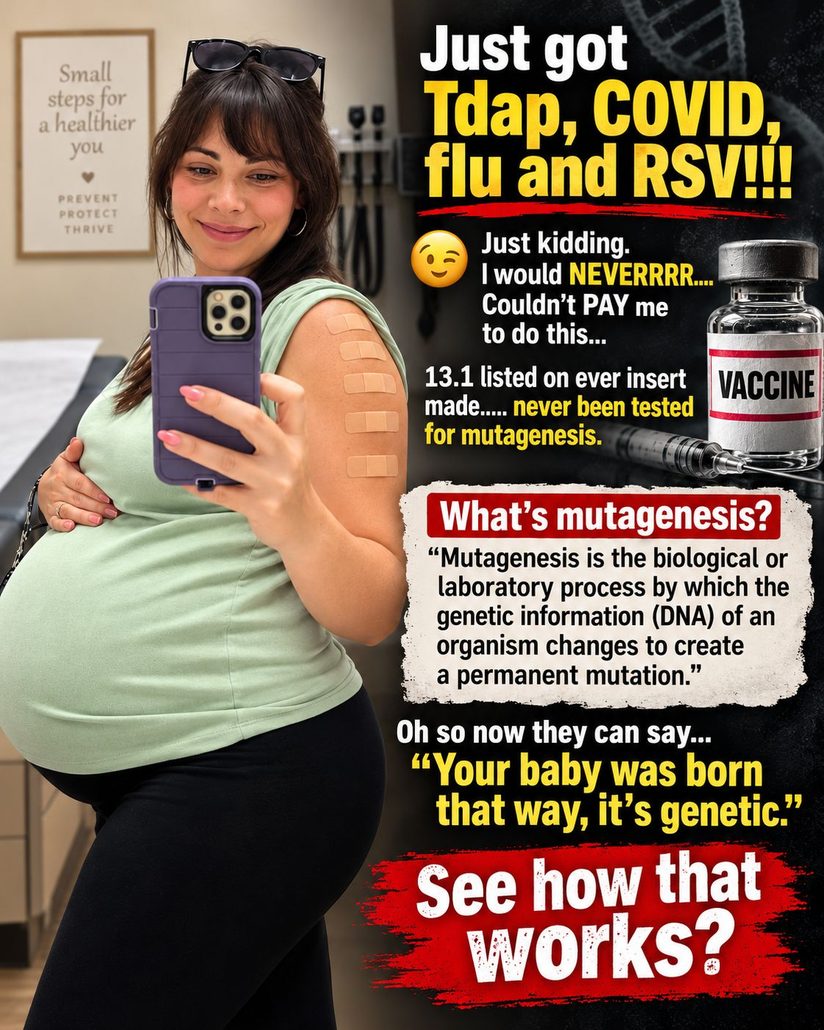
A social media post recently caught my attention. A pregnant woman, Hannah Lee, shared a photograph of herself with several bandages on her arm, announcing that she’d just received four different vaccines.
Then came the punchline.
She was joking. She hadn’t received them and said nobody could pay her to do so.
And apparently, this post has struck a nerve.
At the time of this writing, the post has already attracted 3,700 views and 589 comments. That’s a remarkable amount of discussion surrounding one woman’s decision to question vaccination during pregnancy.
Clearly, this is a subject people have strong feelings about. And judging by the amount of engagement, it’s a conversation worth having.
But for me, the most important part of her post wasn’t the attention it received or the joke. It was the question she raised about something most people probably never read: Section 13.1 of the vaccine manufacturers’ package inserts – Carcinogenesis, Mutagenesis, and Impairment of Fertility.
This is something I believe every parent deserves to understand.
What Is Mutagenesis, and Why Does It Matter?
Mutagenesis refers to the process by which genetic material undergoes changes, potentially resulting in permanent mutations.
When we’re talking about medical products administered during pregnancy, questions about genetic toxicity and fetal development are perfectly reasonable.
And here’s where things get interesting.
Look at the FDA-approved package insert for Pfizer’s RSV vaccine, Abrysvo, which is approved for use during pregnancy.
Under Section 13.1, the manufacturer states:
“ABRYSVO has not been evaluated for the potential to cause carcinogenicity, genotoxicity, or impairment of male fertility.”
That’s not my interpretation. It’s right there in the manufacturer’s documentation.
The same insert also describes developmental toxicity testing in rabbits, so this doesn’t mean the vaccine underwent no reproductive safety testing. But it does raise a question worth asking:
How many pregnant women are told exactly which safety studies were conducted, which weren’t, and why?
Informed Consent Should Mean More Than Being Told Something Is Safe
For more than 30 years, I’ve been asking questions about vaccines, their safety, and the information parents receive.
And one thing continues to bother me.
We’re constantly told to trust the experts. Trust the recommendations. Trust the science.
But trust should never replace informed consent.
A pregnant woman deserves to know what evidence supports a recommendation, what uncertainties remain, and whether the safety of administering multiple vaccines together has been adequately investigated.
To be clear, a statement that a vaccine wasn’t evaluated for mutagenicity does not establish that it causes mutations. Nor does it demonstrate that vaccination causes genetic conditions in children. Those claims require their own scientific evidence.
But acknowledging that distinction doesn’t make the questions disappear.
There are clinical studies and observational safety data supporting maternal vaccination. The CDC recommends vaccines during pregnancy to reduce the risks of serious infections for mothers and infants.
That evidence deserves examination too.
What I object to is the idea that parents should simply accept a recommendation without having the opportunity to examine the evidence themselves.
And What About the Children?
This is deeply personal for me.
Anyone familiar with my family’s story knows why I’ve spent decades questioning vaccines and advocating for informed consent.
I cannot turn back the clock on what happened in my family. But I can continue encouraging parents to ask questions before making decisions that affect their children.
I want expectant mothers to know that a package insert is more than a piece of paper tucked inside a box.
It’s an important document describing what is known about a medical product and the studies supporting it.
My Message to Expectant Mothers
Before agreeing to any medical intervention during pregnancy, ask to see the manufacturer’s full prescribing information.
Read Section 8.1 on pregnancy. Read Section 13.1 on nonclinical toxicology. Ask what studies were performed, what safety data are available in pregnant women, and what researchers have found about outcomes for their babies.
And don’t be afraid to ask for an explanation you can actually understand.
Because informed consent isn’t about blindly accepting a recommendation. It’s about having enough information to make a decision for yourself.
After everything my family has experienced, I will never stop advocating for children.
— Greg Wyatt
A Special Note to Hannah Lee:
Good job, Hannah! It’s refreshing to see someone actually taking the time to read vaccine manufacturers’ package inserts and ask questions about what’s in them. I wish more parents would do the same.
Keep asking questions, Hannah. Never stop seeking answers!
Sources
- FDA — Abrysvo Official Package Insert
- Pfizer — Abrysvo Section 13: Nonclinical Toxicology
- CDC — Guidelines for Vaccinating Pregnant Women
- CDC — COVID-19 Vaccines During Pregnancy