Who Controls the Science Behind Your Prescription?
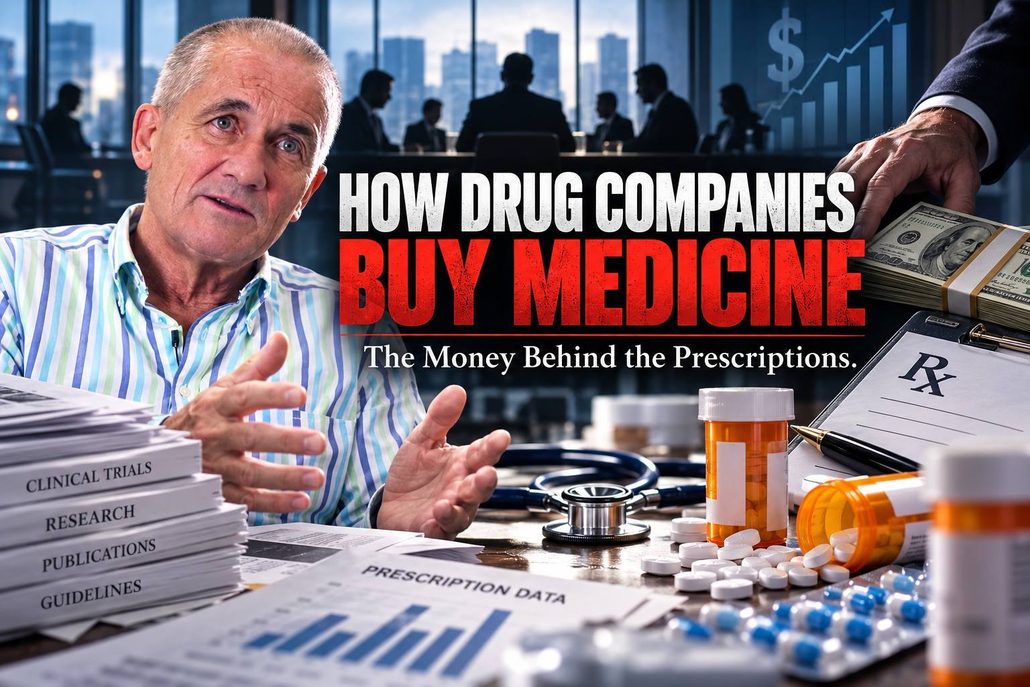
Most patients assume that when a doctor recommends a medication, the decision rests on a solid foundation of independent scientific evidence. The video featured here challenges that assumption by examining how pharmaceutical companies can influence the research, medical literature, treatment guidelines, and prescribing culture that physicians depend on every day.
At the center of the presentation is physician and researcher Peter Gøtzsche, a co-founder of the Cochrane Collaboration. Gøtzsche argues that one of the central problems in modern medicine is that the published scientific literature cannot always be taken at face value. He describes his own early work reviewing trials of arthritis drugs and painkillers, where he concluded that many of the studies were unreliable, and explains how the Cochrane Collaboration grew in part from a desire to examine clinical evidence more rigorously and identify biases that might otherwise remain hidden.
According to Gøtzsche, the problem becomes especially serious when drug manufacturers control or heavily influence the trials used to evaluate their own products. He says unpublished data obtained through litigation have sometimes revealed information that was not apparent in the published record. His concern is not with randomized trials themselves, which he describes as an extraordinarily valuable scientific tool, but with the way those trials can be designed, analyzed, selectively reported, or withheld when commercial interests are at stake.
The consequences, he argues, can be substantial. Gøtzsche says that when pharmaceutical companies manipulate clinical evidence, the result is not merely a distorted academic literature but potentially widespread harm to patients. He is particularly critical of a regulatory system in which agencies depend heavily on information supplied by the manufacturers whose products they are charged with evaluating. If the underlying evidence is incomplete or biased, he argues, regulators and doctors may make decisions on a foundation that appears stronger than it actually is.
Gøtzsche reserves some of his strongest criticism for the pharmaceutical industry’s legal history. In the video, he says he examined the conduct of the ten largest pharmaceutical companies and concluded that their repeated involvement in fraud, kickbacks, corruption, and other misconduct met what he regarded as criteria associated with organized crime under U.S. law. His broader argument is economic: when the profits associated with a drug far exceed the fines imposed for misconduct, financial penalties may do little to change corporate behavior. In his words, “crime pays.”
“The business model of the drug industry is organized crime, but they steal far more money and kill far more people than the mob can ever do.” – Peter Gøtzsche
The presentation then turns to psychiatry, which Gøtzsche describes as an area where pharmaceutical influence has been particularly pronounced. He criticizes the long-standing claim that depression is caused by a simple serotonin deficiency and disputes the common analogy that taking an antidepressant is comparable to a diabetic taking insulin. He argues that the evidence does not support such a straightforward “chemical imbalance” explanation and says that psychiatric drugs can themselves alter brain chemistry in ways that complicate withdrawal and long-term treatment.
Several speakers in the video also raise concerns about the tendency for psychiatric medications to become long-term prescriptions. One physician notes that it is relatively easy to start a patient on a drug but much harder to stop it, particularly when withdrawal symptoms are interpreted as a return of the underlying condition. The discussion also questions guideline recommendations that encourage some patients to remain on medication indefinitely despite, in the speakers’ view, limited evidence supporting lifelong treatment.
This is where the issue becomes broader than any single drug or medical specialty. Doctors generally do not have the time or resources to independently review every clinical trial behind every medication they prescribe. They rely on journals, professional organizations, clinical guidelines, continuing education, and expert consensus. If pharmaceutical influence enters the system at those earlier stages, then an individual physician may be acting in good faith while still relying on evidence or recommendations shaped by commercial interests.
That distinction matters. The argument presented in the video is not simply that doctors are being directly “bought” in the most obvious sense. Rather, it is that the pharmaceutical industry can exert influence throughout the medical information system, from the design and publication of clinical trials to professional education and prescribing guidelines. By the time a patient sits down in an examination room, many of the assumptions surrounding a drug may already have been formed long before that individual doctor makes a decision. Pasted text
The larger question, then, is whether modern medicine has developed sufficient safeguards to separate commercial interests from scientific judgment. If manufacturers are allowed too much control over the evidence used to evaluate their own products, and if doctors and regulators depend on that evidence, the potential for conflict is obvious.
Patients deserve to know not only whether a drug has been approved, but how the evidence behind that approval was produced, who funded it, what data were withheld or unpublished, and whether long-term harms were adequately investigated. The credibility of medicine depends on more than scientific language and regulatory approval. It depends on whether the evidence itself can be trusted.