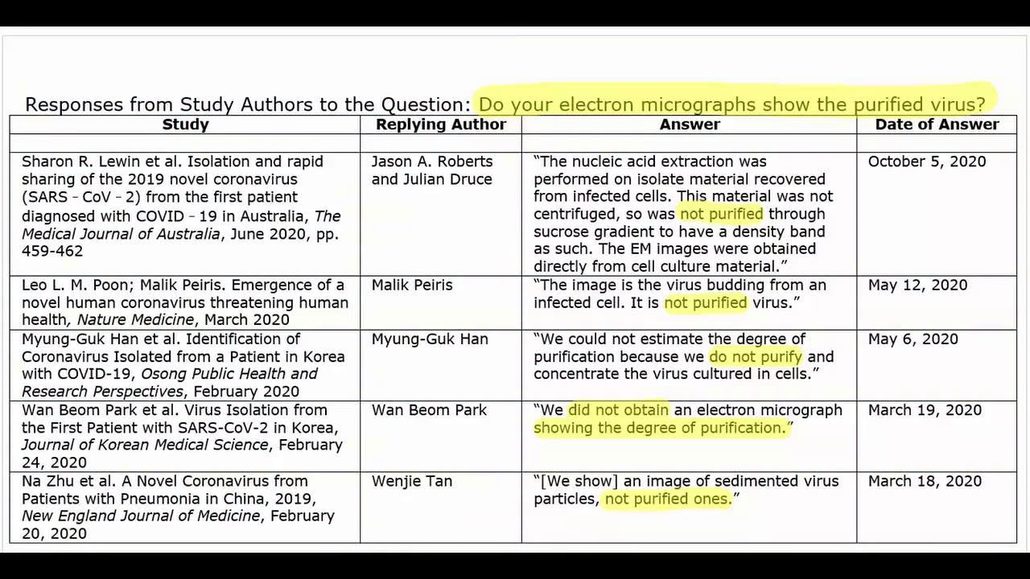
Paper after paper uses the word “isolation,” yet when the authors are pressed on whether their electron micrographs actually show a purified virus, the answer keeps coming back the same: no.
Instead of taking material from a sick person, separating out the alleged virus, and demonstrating that purified particle as the cause of disease, virology relies on cell cultures, added media, antibiotics, serum, and other outside materials. Then, when the cells break down or genetic material is detected, the result is presented as proof that a virus was isolated.
But that is not isolation in the ordinary meaning of the word.
And it does not satisfy Koch’s original postulates.
Koch’s framework required a suspected pathogen to be separated from the diseased host and shown to cause the same disease in a healthy host. With viruses, that direct process is replaced by a laboratory system filled with added biological material. The alleged virus is never shown on its own, purified and free from everything else in the culture.
The chart above is revealing because the researchers themselves acknowledge this.
One author says the material “was not purified through sucrose gradient.” Another says plainly: “It is not purified virus.” Another says they “did not purify and concentrate the virus cultured in cells.” Another admits they did not obtain an electron micrograph showing the degree of purification.
Yet these papers became part of the scientific foundation for one of the largest public-health responses in modern history.
That should raise an obvious question:
If the virus was never purified and demonstrated independently of the cell culture system, what exactly were they proving?
For years, the public was told that SARS-CoV-2 had been “isolated,” “identified,” and “proven.” But when you look closely at the methods, the process is far less straightforward than those words suggest.
Instead of a purified virus, we find mixtures.
Instead of direct proof, we find interpretation.
Instead of Koch’s postulates, we find revised standards created specifically because viruses cannot meet the original requirements.
If a scientific theory requires changing the definition of “isolation” and abandoning the original standard of proof, then the public has every right to ask whether the evidence is as conclusive as they were told.
They told the world the virus had been isolated. The researchers’ own words tell a very different story.
Also watch this video by Alec Zeck
or watch his podcast at