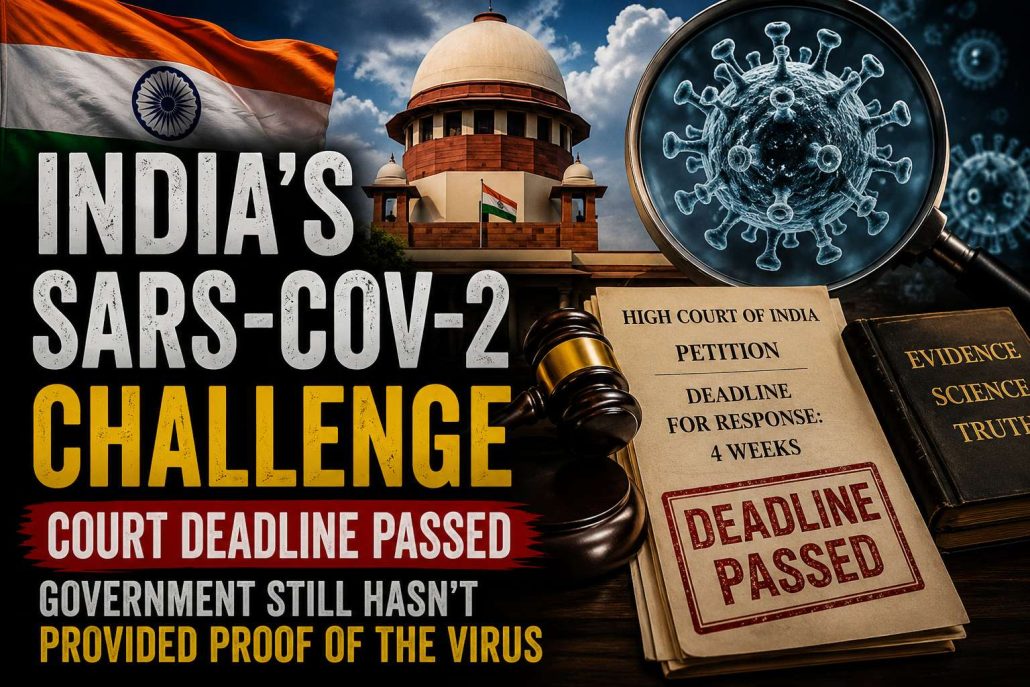
A month ago, I wrote about an extraordinary legal challenge unfolding in India. Petitioners asked the High Court to require government health authorities to provide scientific evidence demonstrating the existence of SARS-CoV-2 and its ability to cause disease.
The case attracted international attention because it challenged one of the central assumptions behind the global COVID-19 response.
At the time, the High Court granted the respondents—including the Union of India—four weeks to file their replies.
That deadline has now come and gone.
A Challenge to Government Health Authorities
According to Dr. Sam Bailey, who has closely followed the case, the petition is about much more than COVID-19.
The petitioners argue that if governments have imposed lockdowns, mask mandates, vaccine campaigns, and other public health measures based on the existence of a disease-causing virus, they should be able to demonstrate the scientific evidence supporting those claims.
The petition states:
“The petitioner is hereby seeking direction from this Honourable Court to direct the concerned respondents to immediately provide substantial evidence and perform real-time practical demonstrations to prove the claimed particles are real physical entities as disease-causing particles called viruses…”
It goes further, asking for evidence supporting broader claims within medical microbiology, including germ theory, immunity, and immunization.
The petitioners contend that if these foundational claims cannot be demonstrated scientifically, they should not continue serving as the basis for national health policy.
Four Weeks Came and Went
When the petition was presented, the High Court granted government counsel four weeks to respond.
According to Dr. Bailey, that deadline passed without the scientific demonstration the petitioners had requested.
Instead, the case proceeded through additional legal filings rather than the presentation of experimental evidence.
Supporters of the petition argue that this reinforces their position that authorities are unable to produce direct scientific proof using the methodology requested by the court challenge.
A Debate That Extends Beyond India
This legal challenge reflects a much broader discussion taking place around the world.
For years, independent researchers, physicians, and scientists have questioned aspects of virology, germ theory, PCR testing, virus isolation methods, and the scientific standards used to establish the existence and pathogenicity of viruses.
Organizations such as No Viruses International argue that modern virology has never adequately demonstrated these claims according to what they consider the scientific method.
Mainstream scientific and public health organizations strongly disagree. They maintain that SARS-CoV-2 has been identified through multiple independent lines of evidence, including genomic sequencing, electron microscopy, viral culture, molecular biology, and decades of virological research. The petitioners dispute that these methods satisfy the standard of proof they are requesting.
Why This Case Matters
Regardless of where one stands in the debate, the case raises an important question.
When governments implement sweeping public health policies that affect billions of people, should they be expected to publicly demonstrate the scientific evidence on which those policies are based?
The answer is YES!
Whether the Indian courts ultimately agree remains to be seen.
As this case continues to unfold, it has become one of the most closely watched legal challenges involving the scientific foundations of modern virology.
I’ll continue following developments as they become available.
Dr. Cowan also decided to chime in….