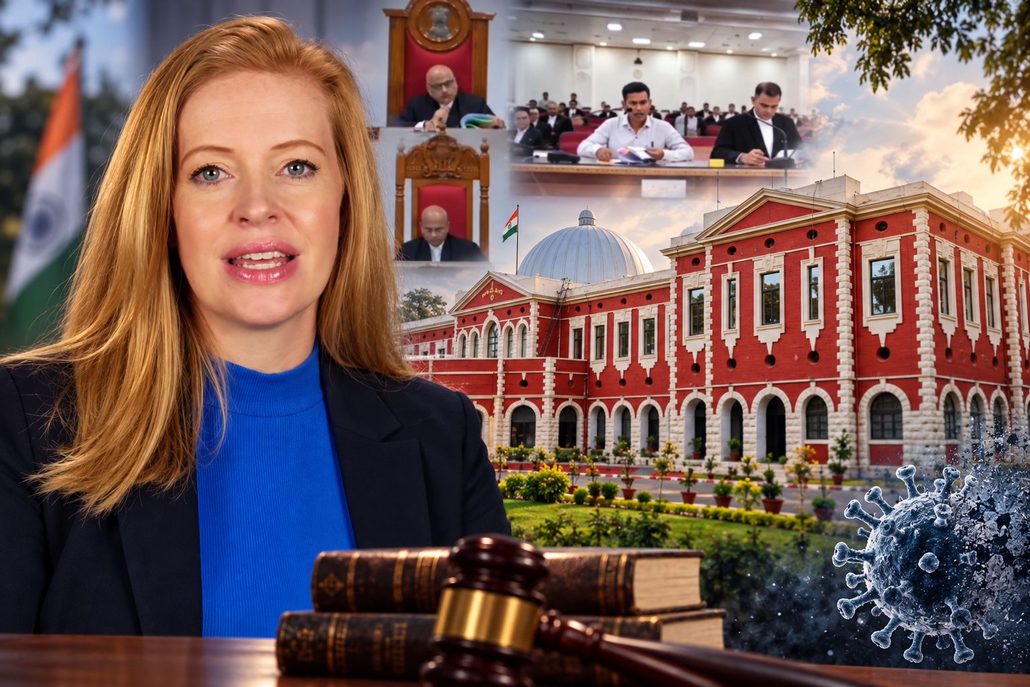
Something deeply troubling is unfolding in an Indian High Court.
Microbiologist Jitendra Banjara has asked government health authorities to produce the scientific evidence they rely upon for some of the most consequential claims in modern medicine: that viruses exist as disease-causing entities, that microorganisms cause disease in the manner described by germ theory, and that policies built around those assumptions are scientifically justified.
These are direct questions.
Yet according to Dr. Sam Bailey’s review of the government’s response, the state does not simply answer them with the requested evidence. Instead, it attacks Banjara’s qualifications, questions his motives, urges the court to defer to established health authorities, and argues that he should prove his own position first.
Perhaps the most extraordinary part is the claim that Banjara is “only a microbiologist” and therefore lacks the necessary expertise to raise these questions.
Think about that.
A trained microbiologist asks government health authorities for the evidence supporting germ theory—and rather than simply producing the evidence, the response reportedly suggests that he is not qualified to challenge it.
That is not a minor side issue. It goes to the heart of the case.
If the evidence is as overwhelming and settled as authorities claim, why should the identity or credentials of the person asking for it matter? The most straightforward response would be to produce the studies, experiments, and demonstrations requested and allow them to stand on their own.
Instead, Bailey argues, the response repeatedly shifts attention away from the underlying questions and toward the person asking them.
The Questions Still Remain
Banjara’s petition reportedly asks for substantial evidence and practical demonstrations supporting the claims of medical microbiology.
The government response, however, reportedly emphasizes that the subject is highly technical and that the court should defer to institutions such as the Indian Council of Medical Research and the World Health Organization.
But that raises another obvious question:
If those institutions possess the evidence, why not simply provide it?
Saying that recognized authorities accept a scientific claim is not the same thing as presenting the experiments that establish that claim.
Bailey also highlights another striking part of the response: the suggestion that Banjara should first prove his own theory to the scientific community.
But he is not asking the government to accept an alternative theory.
He is asking the government to substantiate the theory it already uses to justify public-health policies, medical interventions, vaccines, testing programs, quarantines, and other measures.
Those are very different things.
The burden should not disappear simply because the question is uncomfortable.
Watch the full video by Dr. Sam Bailey