For years, organizations within the so-called “health freedom” movement have mastered the art of emotional fundraising. One of the clearest modern examples may be found in the messaging strategy used by ICAN — the Informed Consent Action Network — led by Del Bigtree.
At first glance, the latest ICAN fundraising email appears to be about microplastics. But when examined carefully, the message reveals something much larger: a sophisticated psychological and emotional formula designed to keep supporters emotionally engaged, politically activated, and financially invested.
The email begins with a familiar setup: institutional betrayal.
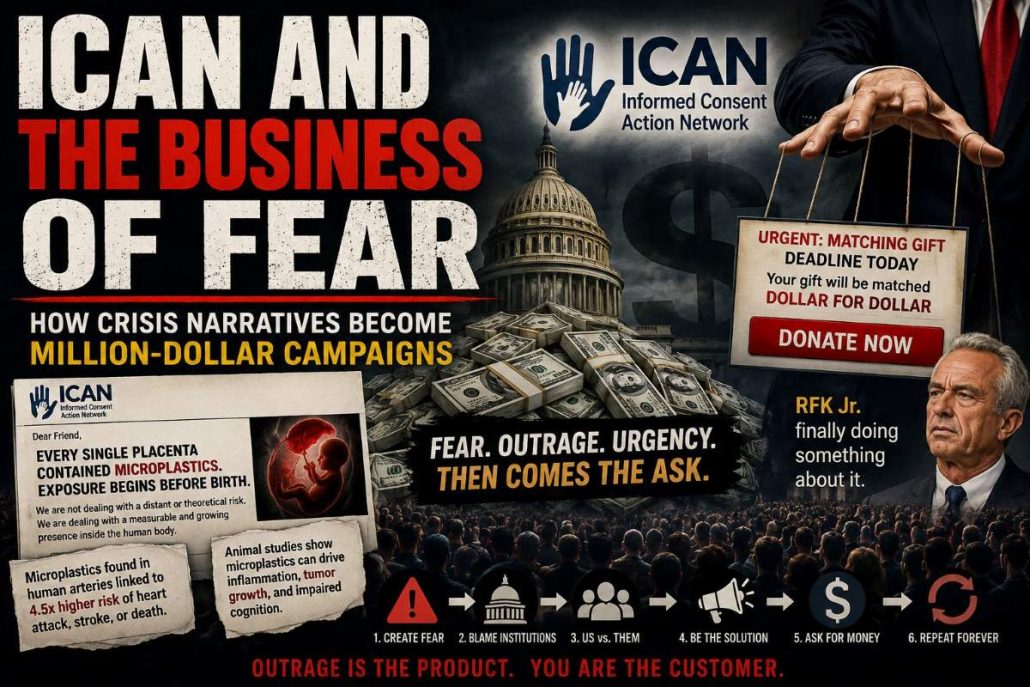
Readers are reminded that government agencies “did nothing for decades.” This immediately establishes distrust and reinforces the belief that corrupt systems have abandoned the public. The next step is fear amplification. The message cites alarming scientific findings about microplastics allegedly being found in placentas, arteries, and diseased tissue. Phrases like “tumor growth,” “higher risk of heart attack,” and “exposure begins before birth” are strategically layered together to create emotional urgency.
Now enters the emotional pivot.
After building fear and distrust, the email suddenly introduces a hero figure — Robert F. Kennedy Jr. — portrayed as the long-awaited reformer finally taking action. This creates psychological relief for the reader. The message essentially says:
“The danger is real. The institutions failed you. But now our movement finally has power.”
That emotional sequence is incredibly powerful in persuasion psychology.
The email then transitions directly into fundraising.
Once fear, outrage, and hope are emotionally activated, readers are asked to donate immediately while their contribution is “matched dollar for dollar.” Matching campaigns are one of the oldest and most effective psychological fundraising tactics because they create the illusion of urgency, scarcity, and amplified impact.
But perhaps the most important thing to recognize is how these narratives continuously expand.
Yesterday it was vaccines.
Today it is microplastics.
Tomorrow it may be food additives, environmental toxins, censorship, artificial intelligence, government surveillance, or another looming catastrophe.
The pattern remains remarkably consistent:
- Introduce a growing existential threat.
- Emphasize institutional corruption.
- Reinforce tribal identity.
- Present the organization as the only trusted source.
- Ask for financial support to continue the fight.
This creates what critics increasingly describe as a self-sustaining outrage economy.
Fear generates attention. Attention generates audience growth. Audience growth generates donations. Donations sustain media operations, legal teams, conferences, documentaries, and political influence. And to maintain momentum, the cycle must continue with new crises, new villains, and new emotional triggers.
None of this automatically means every concern raised by ICAN is false. Microplastics are a legitimate scientific concern being studied worldwide. Institutional corruption does exist in many industries. Regulatory agencies have absolutely failed the public at times.
But that does not mean emotionally charged narratives should escape scrutiny.
The real question becomes: At what point does activism transform into an industry?
At what point does fear itself become the product?
And perhaps most importantly: How many organizations now depend financially on keeping their audiences in a permanent state of outrage, anxiety, and emotional mobilization?
These are questions the public deserves to ask — not only about ICAN, but about the entire modern outrage-driven media ecosystem.
Because when fear becomes profitable, there will always be another crisis waiting around the corner.