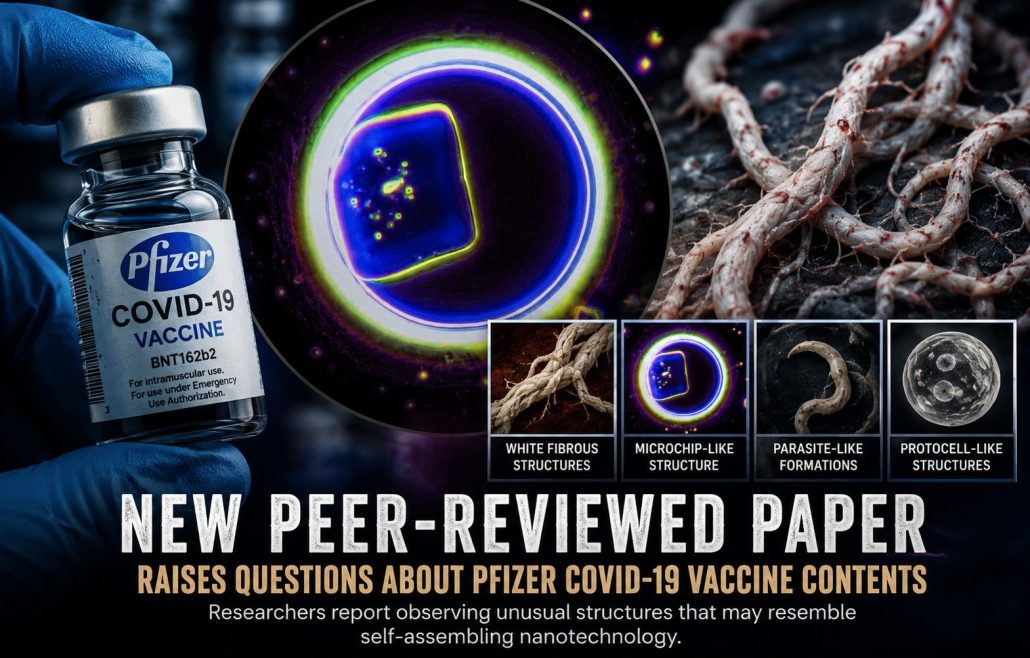
The article reports on a paper published in the International Journal of Vaccine Theory, Practice, and Research by Shimon D. Yanowitz and Daniel Broudy. The paper describes darkfield microscopy observations of material from Pfizer COVID-19 vaccine vials.
According to the authors, when droplets from Pfizer vials were placed on microscope slides, they observed structures that appeared to organize and change over time. These included:
- Long ribbon-like fibrous formations.
- Structures the authors describe as “parasite-like.”
- Large spherical, compartmentalized objects they refer to as “protocells.”
- A rectangular structure embedded within one of the spherical formations, which they speculate could contain “meta-DNA.”
The paper argues that these structures resemble technologies discussed in scientific literature involving:
- DNA origami
- Self-assembling nanotechnology
- Synthetic biology
- Programmable biomaterials
- Molecular communication systems
- Nanorobotics
The authors conclude that the observed structures may represent components of an advanced self-assembling synthetic system and call for further investigation into their composition, origin, and possible biological significance.
Fleetwood also notes that the publication coincides with the CDC awarding Pfizer a new contract worth approximately $1.24 billion for additional COVID-19 vaccine doses, framing the findings as especially significant in light of continued government investment.
For those who have been following independent researchers and social media discussions since the COVID-19 vaccine rollout, these claims are not entirely new. Funeral director John O’Looney has repeatedly reported observing unusual fibrous and rubbery clot-like material during embalming procedures, and others have shared microscopy images and videos they believe show unusual structures associated with the vaccines. These reports have circulated for several years, although they remain controversial and have not been accepted as established scientific evidence. The new paper adds another set of observations to an ongoing debate rather than introducing a completely new claim.
The microscopy observations and interpretations described in the paper have not been broadly accepted by the wider scientific community, and the conclusions about self-assembling nanotechnology, “protocells,” or microchip-like structures remain highly controversial. Demonstrating unusual microscopic images does not by itself establish the identity, function, or origin of the observed material, and independent replication and additional analytical methods would be needed to substantiate such claims.
You can read John Fleetwood’s substack: Microchip-Like, Parasite-Like, and “Self-Assembling Nanotech” Structures Found Inside Pfizer COVID Vaccine (Jon Fleetwood, June 2026)
https://jonfleetwood.substack.com/p/microchip-like-parasite-like-and